Manufacturing Business Loans
Get the capital to buy materials, run your machines, and keep going while net-term customers still owe you.
Apply in minutes and speak with advisors who read production schedules, not just bank statements.
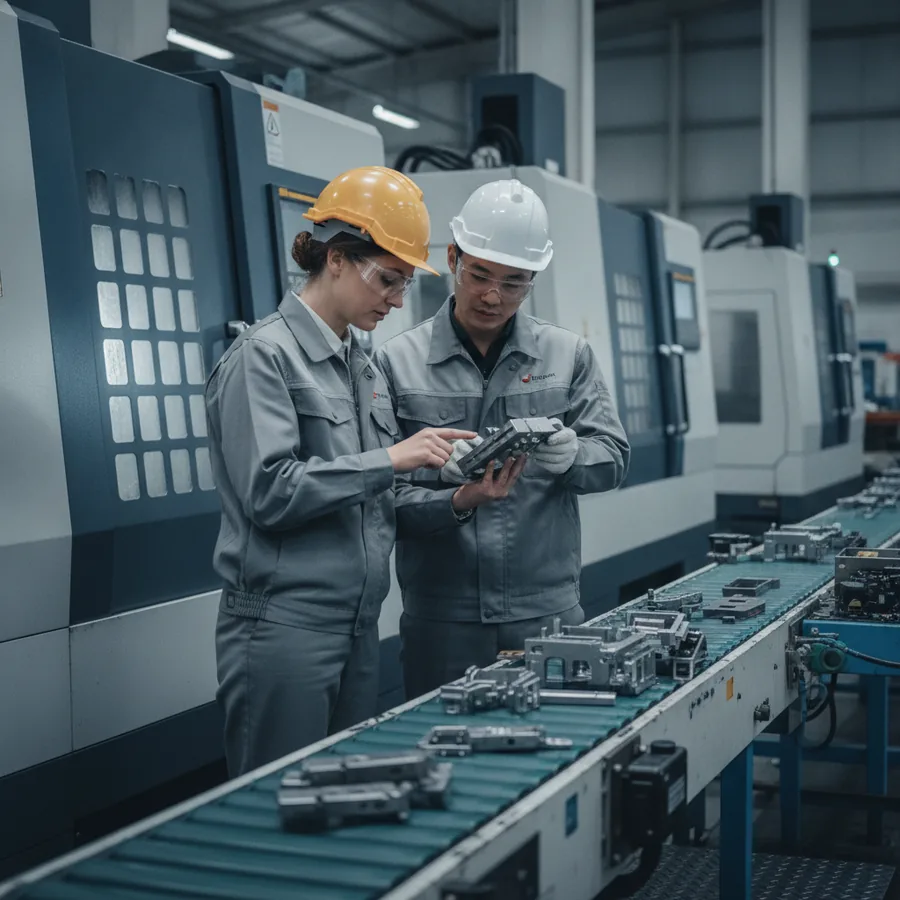
Business loans for manufacturers
You put cash into steel, resin, and components months before a finished order ships and pays you. FundBetter gives manufacturers the capital to stock materials, run the line, and say yes to bigger orders without draining your reserves.
One application reaches one of our funding advisors who understands production cycles, and you get a decision in hours. We have funded more than $1 billion for businesses that make things.
Why manufacturers need working capital
Materials paid upfront
Finance the material bill and a large order never ties up your cash, even though raw materials and components come due long before the finished goods sell.
Net-60 customer terms
Turn those open invoices into working capital right away with factoring, so big buyers can pay on net-60 or net-90 while your costs hit today.
Machines and capacity
Grow capacity now and pay for it as it earns with equipment financing, so a new CNC machine or an extra line opens real revenue without a steep price tag draining you.
How the manufacturing cash conversion cycle works
Fund the gap and you can grow without your own cash running dry, because manufacturing runs on a cycle where money leaves in one quarter and returns in the next. That gap isn't a sign of a badly run plant. It's arithmetic, and it's worth counting in weeks.
Start the clock when a purchase order lands. You release steel, resin, castings, or components in week one. If your suppliers give you net 30, that material bill is paid around week five, in full, before a finished unit has left the building. On a $400,000 order with material at 45 percent of the order, that's roughly $180,000 out the door with nothing to invoice against.
Then the job sits on your floor as work in progress. Machining, forming, welding, and assembly each carry a queue, and every station the job waits in front of is capital parked in material you can't sell. Four to six weeks is normal on a build that size, longer if one machine is the bottleneck. Labor and overhead are paid weekly throughout. Finished goods add another one to three weeks while parts wait for inspection, a full pallet, or a customer release date.
Only then do you ship and invoice, around week nine or ten. That's when customer terms start, not end. A net-60 buyer pays in week eighteen, and large buyers routinely pay past terms without anyone treating it as late. End to end, cash left in week five and came back in week eighteen. That's roughly thirteen weeks of your own money financing one order. Run two at once, which is what growth looks like, and you need twice the cash with no change to your margins.
That's why profitable manufacturers run short of cash. The fix isn't to sell less. It's to shorten the gap with invoice factoring on the receivable end, or bridge it with a business line of credit you draw when material comes due and repay when the customer pays.
Equipment financing vs. a long-term business loan
Match the right one to the job and you keep your borrowing cost down, because manufacturers ask for these two almost interchangeably, yet they solve different problems. Equipment financing buys one identified machine. A long-term business loan funds a project with no single serial number attached to it.
| Equipment financing | Long-term business loan | |
|---|---|---|
| What it funds | One machine you can point to on a quote: CNC, press brake, injection molder, CMM, or a full line | Plant expansion, a build-out, a hiring ramp, or several smaller purchases at once |
| Typical term | 1 to 6 years, set against the useful life of the machine | 1 to 5 years on amounts up to $5M |
| Collateral | The machine secures it, so up to 100% of cost can be covered without pledging other assets | Secured against the business more broadly, which means a stronger financial file |
| Payment size | Smaller monthly, since cost spreads across the years the machine runs | Larger monthly at the same amount, since the term is generally shorter |
| Who it suits | A shop with a clear bottleneck at one operation and quoted work waiting behind it | A manufacturer funding a facility project spread across many line items |
What manufacturing business loans pay for
Put the money where it earns and let the payback profile set the term you take, because five requests account for most manufacturing funding.
CNC machines and production machinery
Buy the machining center, press, molder, or laser that earns, since it's the most common purchase and the easiest to justify. Take utilization on the machine it replaces, add the hours you outsource or turn away, and you have the revenue case.
Tooling, dies, and fixtures for a new production part
Finance tooling separately and a new program never drains the cash existing production needs, which matters because tooling is the awkward spend: a five or six figure cost tied to one program, paid long before the first production run, and rarely funded upfront by the customer.
Plant expansion and additional floor space
Fund the expansion once the plant is truly out of room or out of hours, because a second shift is cheaper than square footage. Build-out, racking, electrical service, and craned bays are the mixed project a long-term loan is built for, and SBA loans suit the case where you're buying the building rather than fitting one out.
Automation and robotics on the production line
Finance a robotic cell or automated inspection station and you strip labor cost or scrap from one operation, so the payback is measurable and easy to underwrite. Include integration and programming in the amount financed, since both run a real share of the hardware price.
Raw material for a single large order
Take the purchase order bigger than anything you have run before without the trouble it usually brings, since material is due weeks before you ship. A short-term loan covers the buy and is repaid when the customer pays.
When to finance new manufacturing capacity, and when to wait
Fund capacity that pays for itself and avoid the machine that becomes a monthly obligation. Adding capacity is the largest funding decision most manufacturers make, and that difference is visible before the order is signed.
Financing new production capacity usually works when
- The machine sits at a real bottleneck and utilization there is high enough that you are quoting long lead times
- You are turning down work or paying an outside shop to run operations you could run in house
- The term is at or below the useful life of the machine, so the asset still earns after the last payment
- Repeat or blanket orders back the new capacity, rather than one program that could end
Hold off on financing manufacturing capacity when
- The plant runs well under capacity and the real constraint is demand or scheduling, not machine hours
- The purchase depends on one customer who has not confirmed with a signed purchase order
- Installation, tooling, foundation work, power, and training are not in the amount financed, which is how a machine quote grows past its sticker price
- Cash is tight because receivables are slow, not because you lack equipment, in which case factoring solves the real problem at lower cost
Best ways to use manufacturing business loans
These are the requests manufacturers bring us most often. Some of them add capacity, and the rest carry a job from material to payment.
Funding options for manufacturers
A machine purchase, a material buy, and a net-60 receivable are three different problems. Each one has a product built for it, and matching them correctly is most of what keeps the cost of borrowing down.
Equipment Financing
Finance production machines and tooling with the equipment itself securing the loan.
Learn moreInvoice Factoring
Turn net-60 customer receivables into cash so the next material buy is not delayed.
Learn moreBusiness Lines of Credit
Buy raw materials in bulk as runs are scheduled and repay when finished goods ship.
Learn moreShort-Term Business Loans
Cover payroll and overtime during a production ramp with a set repayment window.
Learn moreWho qualifies for manufacturing business loans?
Approval leans on shipped revenue and time in business rather than on the size of your plant. Job shops, contract manufacturers, fabricators, and assemblers all qualify under the same basic thresholds.
Check if you qualifyFrequently Asked Questions
How do manufacturers fund a purchase order that is bigger than their cash on hand?
Usually with a short-term loan or a line of credit sized to your material and labor bill rather than to the full purchase order value. If your buyer is on net-60 terms, factoring that invoice can close the gap faster and keep your line open for the next order.
What term should I take on a CNC machine or press?
Match it to the useful life of the machine. Production machinery that will run productively for a decade or more supports a longer term, which keeps the monthly payment low against the hours it bills. Terms on equipment financing generally run 1 to 6 years. Avoid financing a machine past the point you expect to replace or retire it.
Can I finance used manufacturing equipment?
Yes. You can finance used machine tools regularly, and buying used is often your faster route to capacity, because lead times on new machinery can run many months. Age, condition, and remaining useful life affect the term you're offered, so a well maintained machine from a known builder will support better structure than an unsupported one.
Does installation, tooling, and rigging get included in the financed amount?
It often can. Rigging, foundation work, electrical, integration, tooling, and operator training are real costs of putting a machine into production, and leaving them out is a common reason a purchase strains cash after delivery. Bring the full quoted project cost to one of our advisors rather than only the machine price.
My customers ship on blanket orders with partial releases. Does factoring still work?
Yes. Factoring advances against invoices you have already issued, so each release you invoice can be funded as it ships rather than waiting for the whole blanket order to complete. That matters on long programs where the final release may be many months out and the material for it was paid for long ago.
Can I get manufacturing funding if the plant is running below capacity?
You can, and the more useful question is what the money is for. Working capital to cover material, payroll, or slow receivables is a reasonable use while utilization is soft, and revenue-based financing suits a shop whose monthly deposits swing with order flow, because the payment moves with them. Financing an additional machine is harder to justify, because idle machine hours mean equipment isn't the constraint. We'll usually steer you toward a line of credit instead.
Other industries we fund
We know the cash-flow realities of 22 industries. If yours is not Manufacturing, chances are we fund it too.
Accelerate growth with manufacturing business loans
Tell us what you are building and when you get paid for it. Our team will match the funding to your production and collection cycle, with funds available in as little as 24 hours after approval.