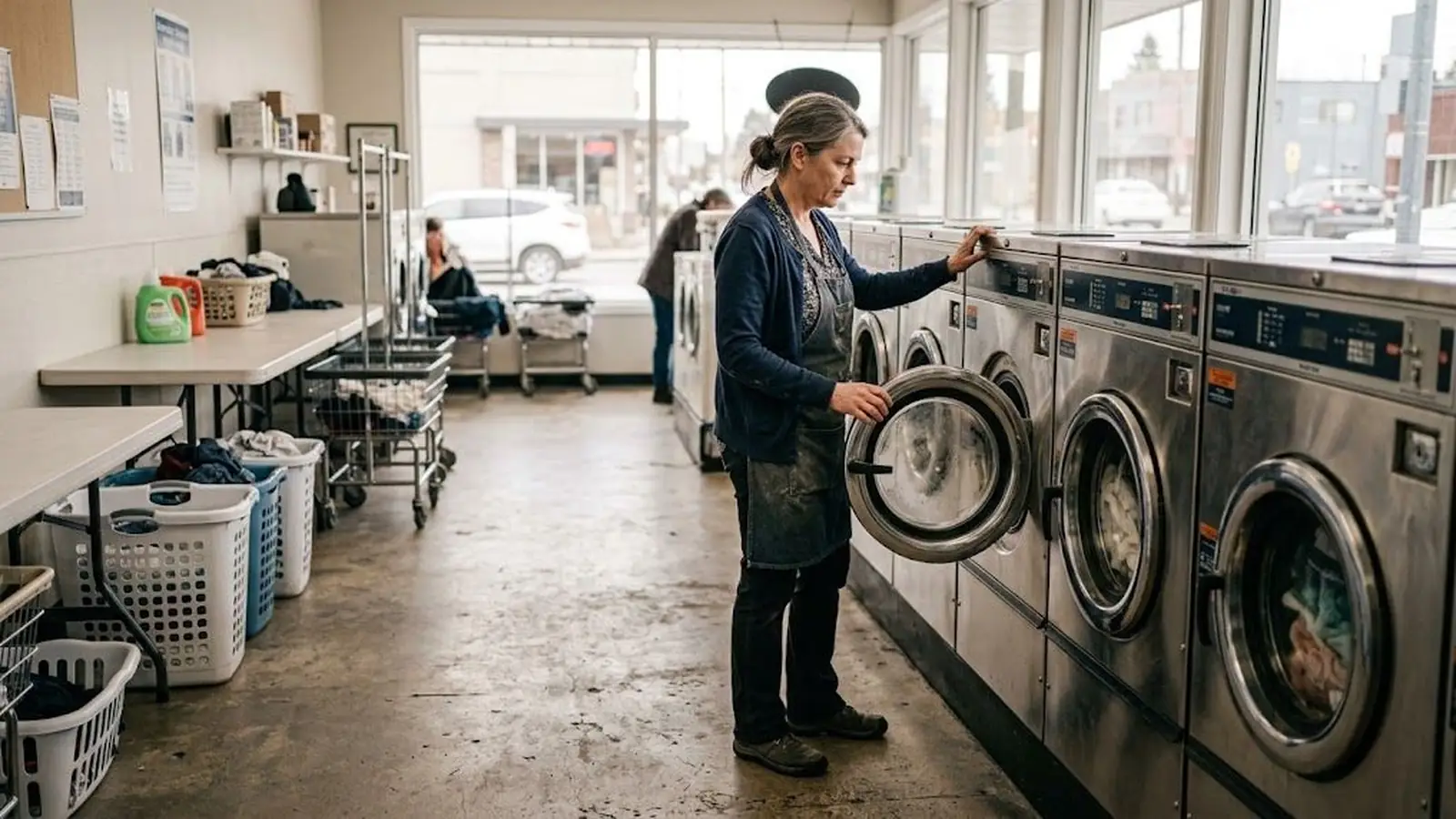
Commercial laundry equipment financing funds the purchase of washers, dryers, payment systems, and related machinery, with the equipment typically serving as the primary collateral. Terms are matched to the working life of the machines, which means an operator can replace a bank of washers without draining the working capital that keeps the business running.
The decision is not only whether the old machines still work. It is also what they cost you while they keep working.
The economics of a replacement cycle
A self-service laundromat is a useful illustration because the asset base is so visible. CLA, The Laundry Association, formerly the Coin Laundry Association, describing the coin laundry segment specifically rather than commercial laundry as a whole, reports about 29,500 coin laundries in the United States generating nearly $5 billion in gross revenue annually, typically on 10 to 25 year leases, with topload washers lasting five to eight years and frontload washers and dryers lasting 10 to 15 years and stores generally occupying 1,000 to 5,000 square feet. Operators serving hospitality, healthcare or other commercial customers work to different economics, including receivables and contract terms that a self-service store does not have.
Inside those life ranges sits the financing question. An older machine may use more water and energy per cycle than a current replacement, may need repairs more often, and may take longer to return to service. Whether that is true of your machines depends on the model, its condition and how it has been maintained, so it is worth answering from your own utility bills and repair invoices rather than from age alone.
Downtime is easy to underweight. A washer out of service in a store with a fixed number of machines does not only lose its own revenue. At peak times it can push customers toward a competitor with working machines.
A long lease makes replacement something you can plan for rather than react to, though equipment ages vary across a floor and the timing depends on what you already have. Planning gives you time to compare structures and terms instead of taking whatever is available the week a machine fails. Emergency replacement can still be financed; it just tends to be arranged under more pressure.
What the financing looks like
| Feature | Typical structure | Why it matters |
|---|---|---|
| Collateral | The equipment being purchased | Other security or a personal guarantee may still be required |
| Amount funded | Often a substantial share of the equipment cost | Preserves working capital for rent, utilities, and payroll |
| Term | Matched to the asset life | Payments spread across the years the machines earn |
| Best fit | Replacement or expansion of machine count | Ties a payment to a revenue-generating asset |
Matching the term to the asset life is the discipline that makes equipment financing work. A five-year note against a machine with a ten-year working life means the asset earns throughout, and earns without a financing payment against it for the second half of its life.
Early payoff is worth asking about at the outset, because agreements differ. Some let you settle the remaining principal and stop the interest. Others set a fixed total cost or apply a prepayment fee, in which case paying early saves less than you would expect.
Replacement, expansion, or paying cash
Three different decisions get grouped under the same heading.
Replacing aging machines is an arithmetic exercise. Add the verified utility savings, the reduction in repair costs, and the revenue recovered from less downtime, then weigh that against the financing payment and the other costs attached to the change, including installation, any downtime during changeover, and the tax and depreciation treatment. Where the verified benefits exceed those costs, the replacement can improve monthly cash flow. Where they do not, waiting is reasonable.
Adding machine count is a capacity and mix decision. It can pay where a store is turning customers away at peak, and it can also pay by cutting wait times, adding larger-capacity machines that carry higher vend prices, or replacing capacity that is underperforming. What it does not do on its own is create demand, so the case has to rest on something specific about how the floor is used.
Paying cash is a trade rather than a mistake. It avoids financing costs entirely and reduces the liquidity available for a rent increase, a utility spike, or a slow quarter. Financing costs more in total and leaves the reserve intact. Which is right depends on how much cushion the business has and how predictable its revenue is.
Finance Your Laundry Equipment with FundBetter
FundBetter is a national small business lender and funding marketplace, founded in 2018 and based in Miami. It may fund directly or connect a business with third-party lenders and funding partners, depending on which is the better fit, with funding from $5,000 to $5 million across eight products. Equipment financing has its own starting points, which differ from the general working capital minimums: one or more years in business, a personal credit score around 500 or higher, and a quote or invoice for the equipment being purchased. Terms run from one to six years and are matched to the useful life of the asset, and many programs cover up to 100 percent of the cost. Checking your options uses a soft inquiry that does not affect your credit score; a hard inquiry happens later, with your permission, only on certain offers.
Machine purchases are funded through equipment financing, larger buildouts and multi-store investments through long-term business loans, and utility or rent gaps between quarters through a business line of credit.
If the repair invoices and downtime already cost more each month than a payment would, you have your answer on timing. Check your rate with the supplier's quote for the new machines, and we'll match the term to how long they'll actually run.